Verbal Reasoning Test
The verbal reasoning test is a form of psychometric and cognitive aptitude test.
Verbal reasoning tests are designed specifically to measure the candidate's understanding and interpretation of written information. Such a test can be of different complexity levels, depending on the position in question.
Generally speaking, graduate and managerial positions require more advanced verbal reasoning skills, such as the ability to comprehend written reports, draw accurate and logical conclusions from various texts, and communicate information to others in a clear and unambiguous manner. These skills are also required for non-managerial roles such as sales and administrative positions.
What Are the Main Components of a Verbal Reasoning Test?
Candidates may come across various types of exercises, for example:
- True/False/Cannot say
- MCQ
- Comprehension-deduction (text comprehension)
- Analogies
- Critical verbal reasoning
- Syllogisms
- Odd One Out
- English test
- Start practicing now
Online Tests – Verbal Reasoning Practice Tests
Prepare effectively for verbal reasoning assessments with our comprehensive packs designed to suit every level and need.
Express Pack - €39 (instead of €49):
- A selection of 20 online mini tests covering key verbal reasoning skills, including synonyms, antonyms, analogies, vocabulary, reading comprehension, syllogisms and advanced verbal logic.
- Includes 3 realistic full practice tests to train under conditions close to a real assessment.
- Offers over 350 questions, with detailed explanations and performance statistics.
- Ideal for fast, targeted preparation, especially for candidates who have a verbal reasoning test in just a few days.
- Please note: this pack is more limited and includes only a selection of the available exercises and practice tests.
Premium Pack - €59 (instead of €79):
- Includes 45 mini tests covering all verbal reasoning topics, from beginner to advanced level.
- Features 7 realistic full practice tests at different difficulty levels for a complete and progressive preparation.
- Provides a total of 1,099 questions, carefully designed by experts.
Included in both packs:
- Unlimited online access, anytime and on any device, via our web platform and mobile application.
- Practice tests that closely reflect the most common formats used in recruitment assessments.
- A detailed performance report with your results, correct answers, clear explanations and comprehensive statistics.
- A verbal reasoning PDF guide with practical tips and strategies.
- Up to 10 attempts allowed per practice test.
- Secure payment and instant access.
How Does a Verbal Reasoning Test Work?
Typical Verbal Tests
- "True": The statement logically follows the information provided in the passage.
- "False": The statement does not logically follow the information provided in the passage and thus is incorrect.
- "Impossible to determine" or "Cannot Say": The passage is neither true nor false; further information is needed in order to determine the accuracy of the given statement.
An Example of a cut-e scales Verbal Test
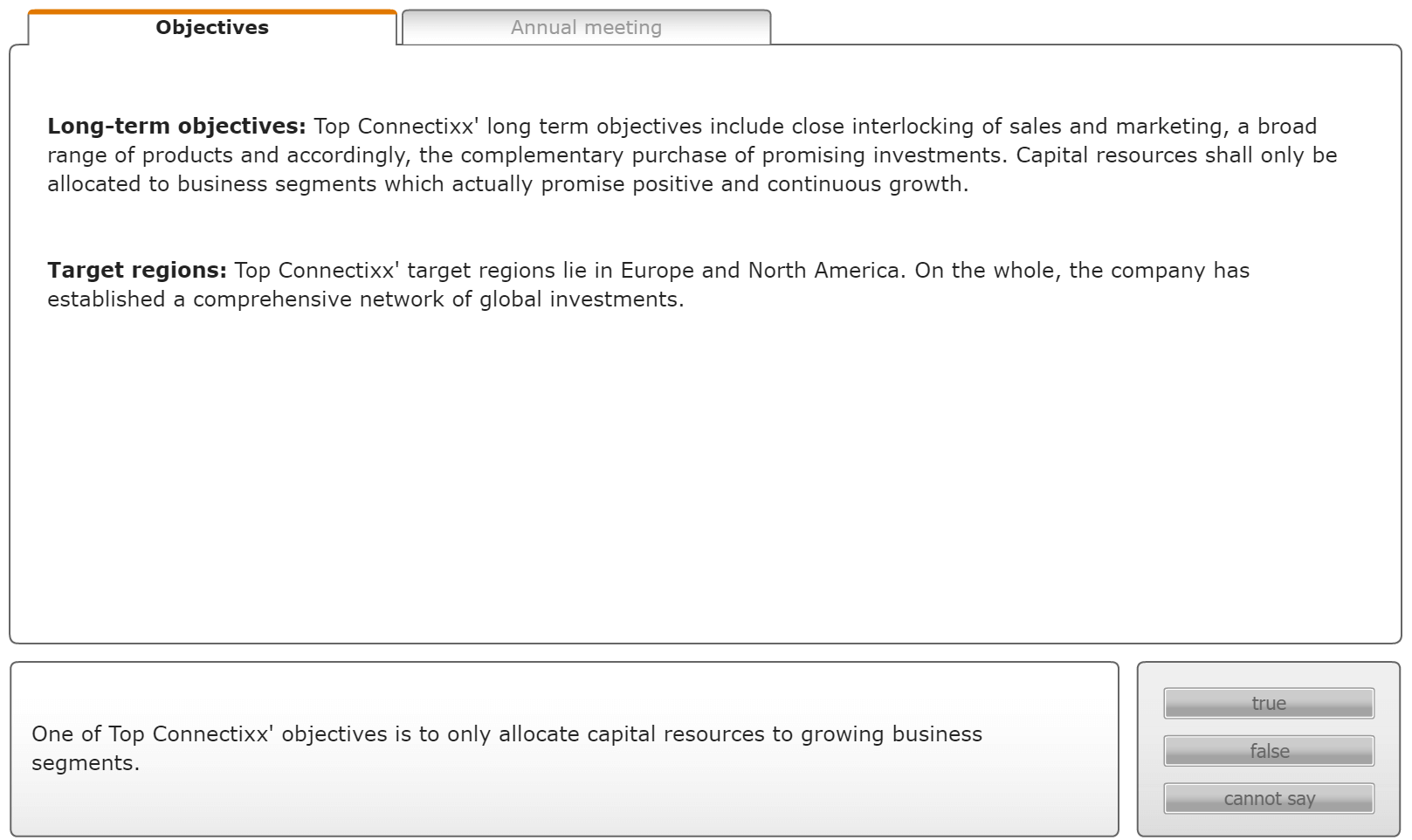
Answer
The correct answer is the answer A : 'True'
Multiple Choice Questions (MCQs)
This is a different form of verbal test in which the candidates are asked to choose one answer out of multiple choices provided for each question (MCQ). The questions are usually based on provided statements or passages, comprised of two or three sentences. The candidate's goal is to determine which statement or hypothesis is most appropriate, based on the given statement. Various forms of questions may be utilized; the examinee may need to choose the answer which most accurately summarizes the given situation, answers derived from logical conclusions and at times, the single answer that is incorrect. It is therefore extremely important to read the question thoroughly and understand what exactly is asked of you.
Comprehension-Deduction Questions
In these type of questions the candidate will be confronted with a text of varying length, content and levels of complexity. Following the text, a number of questions are presented, allowing the examinator to analyse the candidate’s understanding of the text. Some questions may require the candidate to explain certain quotations from the text, whilst others may require the establishment of logical titles for the relevant tests, or to come up with a detailed conclusion to the reality presented.
Examples from SHL
Many organisations consider it advantageous to hire students during the summer months. Permanent employees frequently choose to take their annual leave at this time. In addition, businesses often face increased workloads in the summer, creating a need for additional staff. Employing students over the summer can also serve as a recruitment strategy, as some may return to the organisation as qualified employees after completing their studies. Providing students with the opportunity to gain substantial insight into the organisation can encourage them to pursue permanent roles in the future. Typically, students are paid at a fixed rate and do not receive the standard benefits such as paid leave or bonus schemes.
Statement 1: It is possible that students carry out the duties of permanent employees who are on leave.
- True
- False
- Cannot Say
Statement 2: Summer employees who are students receive the same paid holiday entitlement as permanent staff.
- True
- False
- Cannot Say
Statement 3: Students employed during the summer are governed by the organisation’s usual disciplinary and grievance policies.
- True
- False
- Cannot Say
Statement 4: Certain companies experience higher workloads in the summer when students are available for temporary work.
- True
- False
- Cannot Say
Answer
Affirmation 1 : True
Affirmation 2 : False
Affirmation 3 : Cannot Say
Affirmation 4 : True
Analogies
Analogy questions involve a pair of words present in a statement, followed by four different pairs of words. The exercise's purpose is to determine the logical relationship between the given words, and then choose the answer in which the duo follows the same logic.
In order to arrive at the correct answer in analogy questions, it is necessary to focus on a number of elements. In such questions there are a number of commonly used connections:
Degree of intensity: The second word is equivalent to the first and differs only in intensity; usually taken to the extreme.
Example: love - worship; intolerant - racist
Cause and effect: The second word can be caused by the first or vice versa.
Example: bomb - destruction; ambition - success
Synonyms: Both words have similar meanings.
Example: caution - safety; knife - dagger
Antagonism: The two words have opposite meanings.
Example: prey - predator; pleasant - unpleasant
Item to category: One of the words constitutes a category and the other word acts as a suitable item.
Example: blue - color; dictionary - definition.
Many other types of links exist, including the combination of several types of the links mentioned above.
Tips and Tricks
- It is crucial to pay attention to the order of words! Answers which appear to be of similar logic to the given analogy may be false due to the words being presented in a different order.
- The grammatical form of the words in the pairs is decisive.
- Generally speaking, the easiest way to find the connection between given words is by creating a sentence containing and linking between the two. You must then insert the proposed duo in the same manner and decide if there is a suitable match. It is important to check all possible answers; it is possible that more than one word duo will match the sentence, in which case you will need to create a new sentence with a narrower link between the two words.
Critical Verbal Reasoning
The critical verbal reasoning test constitutes an integral part of cognitive tests, the critical verbal reasoning test being one of the most complicated among them. This mode of reasoning is based on several keywords.
Arguments: According to the Larousse dictionary, an argument is a reasoning; a proof intended to support information. In critical reasoning questions, the argument is of particular structure and is comprised of two parts:
- A premise: a proposal put forward in support of a conclusion.
- A conclusion: a consequence deduced from a reasoning or observation.
Familiarity with the argument's structure and its impact on the text is essential when taking a critical reasoning test. Indeed, the statement will generally present different arguments that the candidate will need to analyse, in order to determine which of the conclusions given as options best corresponds to the question.
Inference: An inference is a conclusion which can be obtained from certain observations or supposed facts. Many of the questions that appear in verbal critical reasoning tests make use of this element. The Watson-Glaser Critical Thinking Appraisal, published by Pearson, is one of the best known tests of this kind.
In exercises such as these, the candidate is asked to recognize the veracity of a proposed inference. The question will then offer five possible answers:
- True: The inference is definitely true and this statement is based on the proposed facts.
- Probably true: In light of the observed facts, the inference is more likely to be true than false.
- Insufficient data: The proposed facts do not allow for the making of any formal conclusion.
- Probably false: In light of the facts observed, the inference is more likely to be false rather than true.
- False: The inference is definitely false, the facts are misinterpreted or contradicted by the inference.
The Syllogism
The syllogism, invented by Aristotle, consists of two propositions (called "premises") from which a third is deduced ("conclusion"), thus linking three statements or arguments. The two premises are often of the following form:
- The major premise, considered to be the most general statement, is the sentence containing the major term.
- The minor premise is the sentence that contains the term for the concluding statement of the syllogism.
The third sentence will contain the conclusion, deduced from the two premises. This consequence may be legitimate or illegitimate; a conclusion is illegitimate when, even though the premises are true, the outcome does not correspond to the statements of the first two exposures.
Example
Statements:
All pens are pencils.
No pencil is a cap.
If these two statements are true, what is the most logical conclusion?
- All caps are pencils.
- Some caps are pencils.
Give answer:
- if only conclusion I follows
- if only conclusion II follows
- if either conclusion I or II follows
- if neither I nor II follows
- if both conclusions I and II follow
Answer
The right answer is D. Indeed, none of the conclusions presented are true.
Important
When you are taking aptitude tests such as the verbal reasoning test, you must always rely on the information presented. The purpose is to test your deductive reasoning, not general knowledge.
English Test
The rules of English are the principles that govern the basics of the English language, covering vocabulary, grammar, conjugation and spelling. The questions that appear in the various language verbal ability tests are frequently cited and are not as simple as they may seem at first glance. Indeed, even the greatest admirers of the English language will be put to the test by these type of questions. The questions may take the form of missing-word statements, be presented in multiple spellings, or refer to different times.
Definitions
According to the dictionary, the meaning of the word 'definition' is: determining the characteristics of a concept, a word, an object, etc; all the essential properties of something.
Example of an Exercise
The definition of the saying "make it up" is:
- Bluffing
- Betrayal
- Hiding out
- To triumph
Answer
The correct answer is answer A: Bluffing
Synonyms
According to the dictionary, the definition of a synonym is: terms that can be substituted for each other in a statement without changing its meaning.
Examples
1. Select the synonym of semblance.
- Personality
- Image
- Attitude
- Ambition
Answer
The correct answer is answer B: Semblance and image are synonyms.
2. Choose the synonym pair.
- Private and Public
- Intrusive and Invasive
- Mysterious and Unknown
- Common – Unique
Answer
The correct answer is answer B: Intrusive and invasive are synonyms.
Paronyms
According to the dictionary, the definition of a paronym is: words of different meaning but of relatively similar form.
Examples
collision : collusion
personnel : personal
affect : effect
deprecate : depreciate
Antonyms
According to the dictionary, the definition of an antonym is: a word with a meaning that is contrary to that of another.
Examples
hot : cold
holidays : school
snow : ice
ugliness: beauty
woman: daughter
Homonyms
According to the dictionary, the definition of homonym is: each of two or more words having the same spelling or pronunciation but different meanings and origins.
Examples
- address (to speak to) / address (location)
- air (oxygen) / air (an impression of a quality or manner)
- band (a musical group) / band (a ring)
- bark (the outer layer of trees) / bark (the sound a dog makes)
- current (up to date) / current (flow of water)
Odd One Out
'Odd one out' questions are common in verbal comprehension tests and are not as easy as they seem at first glance. It is therefore important to be aware of the pitfalls that are often present in these types of questions.
Example
1. Find the odd one out in the following series of words:
- September/August/June/Monday
- Speak/Listen/Talk/Say
- Tall/Happy/Sad/Surprised
2. Example from Talogy (Cubiks) Logiks General (Intermediate):
Which of the following is the odd one out:
- Coin
- Banknote
- Cheque
- Letter
- Credit Card
Answer
The correct answer is the answer D: 'Letter'
Editors of Verbal Reasoning Tests
| Tests Publishers | Assessment Tools |
|---|---|
| SHL | Verify Verbal Ability Test |
| Maki | Verbal Reasoning Test |
| Aon (cut-e) | scales verbal admin |
| Aon (cut-e) | scales verbal consumer |
| Aon (cut-e) | scales verbal finance |
| Aon (cut-e) | scales verbal industry |
| Aon (cut-e) | scales verbal instruct |
| Saville | Swift Analysis Verbal & Numerical |
| Saville | Swift Executive Aptitude |
| Saville | Swift Executive Aptitude |
| Talogy (Cubiks) | Logiks General Intermediate |
| Talogy (Cubiks) | Logiks General Advanced |
| Pearson TalentLens | Core Abilities Assessment |
| Pearson TalentLens | Watson-Glaser Critical Thinking Appraisal |
| Pearson TalentLens | Differential Aptitude Tests |
| Thomas International | General Intelligence Assessment (GIA) |
| Selor | Capacité de Verbal Reasoning Test |
| EPSO (Prometric) | Verbal Reasoning Test (AST & AD) |
| Capp | Verbal Reasoning Test |
| Revelian | Verbal Reasoning Test |
| ACER | Verbal Reasoning Test |
| Hogan Assessments | Hogan Judgment |
| Hudson | Verbal Reasoning Ability Test |
| Talent Q (Korn Ferry) | Elements |
| Talent Q (Korn Ferry) | Aspects Ability Checking |
| Criterion Partnership | Utopia Verbal ability |
| Criterion Partnership | B2C Verbal ability |
| Criterion Partnership | CWS Verbal ability |
| Kenexa (IBM) | Verbal Reasoning Test |
| PSI | PPM Verbal Reasoning Test |
| OPC Assessment | Transport Verbal Reasoning Test (TVRT) |
| OPC Assessment | Professional Verbal Reasoning Test (PVRT) |
| OPC Assessment | Core Skills Verbal Test (CoreV) |
| OPC Assessment | Transport Verbal Reasoning Test (TVRT) |
| Tazio | Verbal Reasoning Test |