Maki Tests: How They Work, Examples, Test Types, and Tips
Maki (also known as Maki People or Maki Assessments) is quickly becoming one of the new standards in recruitment. More and more companies are using this platform to evaluate candidates during the very first stages of the hiring process, through a series of short, interactive, and often timed assessments.

Wise (TransferWise), BNP Paribas, MAIF, Deloitte, Banque de France, H&M, PwC, Capgemini, Sogeti, Louis Vuitton, Dior, IKEA, McDonald's, Nespresso, Forvis Mazars, Grant Thornton, Clarins, Abercrombie & Fitch, Riyadh Air, Foundever, General Concierge Services, BPO, Adecco Medical, QUARTUS, Spline, Respaid, Allocab, SproCLUB, Stealth startup, Northern Trains, Efficio Consulting, PMU, BDO France, Voodoo, Prolific, Mon Marché, KparK, Urbest, Great Ponton Limited, GoodEd Technologies, État de Genève, Harry Potter Societies, MindNET Technologies, Louis Vuitton, Dior, IKEA, Europ Assistance, INGA, Royal Dutch Football Association (KNVB), Reforge, Vahura, OECD, and even FIFA.
What does this mean for you?
Even before an interview, you'll likely be asked to complete a Maki assessment. These tests help recruiters better understand your skills–logical reasoning, reading comprehension, English proficiency, personality, professional judgment, and more.
Your results are automatically analyzed and may determine whether you move on to the next stage. That's why it's essential to prepare properly.
What Is Maki?
Maki is a testing platform used by recruiters to quickly and objectively assess candidates' skills during the early stages of the hiring process.
It offers a library of over 300 tests covering five main categories:
- Cognitive abilities: logic, memory, speed, attention, problem-solving.
- Verbal and numerical reasoning: reading comprehension, simple or complex calculations, data analysis, logical sequences, abstract reasoning.
- Soft skills: judgment, empathy, attention to detail, adaptability, communication, teamwork.
- Language skills: reading and listening comprehension, writing, grammar, spelling–in more than 20 languages.
- Job-specific professional skills: accounting, digital marketing, web development, project management, customer service, and more.
Maki tests are short (typically 5 to 15 minutes), interactive, sometimes even engaging, and designed to be taken entirely online–on a computer or a mobile device. They are presented in a clean, minimalist interface, with a visible timer and easy-to-understand instructions.
The goal is to simulate real-life work situations or tasks to evaluate what you can actually do–not just what's written on your resume.
Prepare for the Maki online tests (now including new tests!)
Access two complete preparation packs designed to help you succeed in the Maki tests, depending on your goals.
The Express Pack offers fast and focused preparation — perfect when you need to train efficiently in a short amount of time.
The Premium Pack provides full and in-depth preparation, covering dozens of skills, exercises, and formats used in Maki assessments.
Practice under real test conditions, track your progress with detailed statistics, and improve quickly with timed tests and clear explanations.
Premium Pack - €49 (instead of €69)
Included tests:
- English B2: 16 questions - 6 minutes (2 tests)
- English C1: 16 questions - 6 minutes (2 tests)
- French C1: 16 questions - 10 minutes (2 tests)
- French Mastery: 70 questions - 20 minutes
- Reading Comprehension: 18 questions - 6 minutes (3 tests)
- Numerical Reasoning: 9 questions - 10 minutes (4 tests)
- Time Problems: 20 questions - 5 minutes
- Logical and Basic Reasoning: 12 questions - 10 minutes
- Spatial Reasoning: 9 questions - 5 minutes
- Problem Solving: 6 questions - 10 minutes
- Advanced Problem Solving: 12 questions - 10 minutes (2 tests)
- Attention to Detail (text): 12 questions - 7 minutes (3 tests)
- Attention to Detail (visual): 8 questions - 6 minutes
- Perception Speed: 15 questions - 12 minutes (4 tests)
- Computer Proficiency: 16 questions - 12 minutes (6 tests)
- Microsoft Excel: 10 questions - 5 minutes (3 tests)
- Effective Communication (SJT): 13 questions - 10 minutes
- Conflict Resolution (SJT): 10 questions - 10 minutes
- Adaptability (SJT): 10 questions - 8 minutes
- Customer Advisor (Banking): 10 questions - 10 minutes
- Call Center SJT Assessment (English): 12 questions - 12 minutes
- B2B Sales – Identifying Customer Needs: 10 questions - 8 minutes
- B2B Sales – From Offer to Closing: 10 questions - 6 minutes
- B2B Sales – Fundamentals: 12 questions - 8 minutes
- B2B Sales – Opportunity Generation: 10 questions - 8 minutes
- Personality Assessment: 50 items – no time limit
- Listening Proficiency Assessment (English): 10 questions - 10 minutes
- SQL: 12 questions - 7 minutes (3 tests)
Summary of the Premium Pack
50 tests – more than 740 questions.
The most comprehensive preparation available: reasoning, languages, IT skills, professional competencies, situational judgment, attention, perception, and more. Everything you need to excel in Maki tests.
Express Pack - €39
Included tests:
- English B2 - Test 1: 16 questions - 6 minutes
- English C1 - Test 1: 16 questions - 6 minutes
- French C1 - Test 1: 16 questions - 10 minutes
- French Mastery: 70 questions - 20 minutes
- Reading Comprehension - Test 1: 18 questions - 6 minutes
- Numerical Reasoning - Test 1: 9 questions - 10 minutes
- Time Problems: 20 questions - 5 minutes
- Logical and Basic Reasoning: 12 questions - 10 minutes
- Spatial Reasoning: 9 questions - 5 minutes
- Problem Solving: 6 questions - 10 minutes
- Advanced Problem Solving - Test 1: 12 questions - 10 minutes
- Attention to Detail (text) - Test 1: 12 questions - 7 minutes
- Perception Speed - Test 1: 15 questions - 12 minutes
- Computer Proficiency - Test 1: 16 questions - 12 minutes
- Microsoft Excel - Test 1: 10 questions - 5 minutes
- Effective Communication (SJT): 13 questions - 10 minutes
- Conflict Resolution (SJT): 10 questions - 10 minutes
- Adaptability (SJT): 10 questions - 8 minutes
- Customer Advisor (Banking): 10 questions - 10 minutes
- Call Center SJT Assessment (English): 12 questions - 12 minutes
- B2B Sales – Identifying Customer Needs: 10 questions - 8 minutes
- B2B Sales – Fundamentals: 12 questions - 8 minutes
- Personality Assessment: 50 items – no time limit
- SQL: 12 questions - 7 minutes
Summary of the Express Pack
24 tests – more than 400 questions.
The ideal preparation to quickly understand Maki test formats, revise efficiently, and progress in a short time.
Included in both packs
- 100% online training platform.
- Timed simulations that mirror real Maki test conditions.
- Comprehensive reports with detailed performance statistics.
- Up to 10 attempts per test.
- Secure payment and instant access.
- The number of questions and the duration listed correspond to each individual test, accurately reflecting the structure of Maki People assessments.
Why Choose Our Preparation?
- Tests designed to closely match real Maki assessments
- Timed conditions replicating the actual test experience
- Detailed reports and performance statistics
- Content written by experts in cognitive assessment and recruitment
The Maki Test Library
Maki offers a rich and diverse library of over 300 tests, organized into five main categories.
1. Job-Specific Tests
These tests are designed to assess skills specific to a particular profession or industry.
Subcategories:
Total: Over 134 different tests
- Human Resources
- IT and Telecommunications
- Marketing
- Product Management
- Project Management
- Sales
- Software Development
- Strategy and Transformation
- Operations
- Administration and General Services
- Construction
- Customer Service
- Data Analysis
- Finance and Accounting
- Healthcare
- Hospitality and Catering
Average duration: 5-10 minutes
Format: Short multiple-choice questions, fully online
Examples:
- Facebook & Instagram Ads
- Python Coding
- Mechanical Engineering
- Executive Assistant
- Client Onboarding
- Salesforce
- Financial Forecasting
- Retail Pricing
2. Core Skills
Core skills are essential across all professions, regardless of the industry. They reflect general abilities such as following instructions, managing time effectively, or using basic office software.
Over 16 different tests available
Examples of tests:
- Basic Computer Operations (Windows) - 10 questions - 6 minutes
- Basic Math II - 10 questions - 5 minutes
- Basic Math III - 10 questions - 5 minutes
- Following and Understanding Instructions - 10 questions - 6 minutes
- Following and Understanding Instructions (Landscaping) - 16 questions - 10 minutes
- Giving and Receiving Feedback - 50 questions - no time limit
- Meeting Management - 12 questions - 7 minutes
- Microsoft Excel - Beginner Level - 9 questions - 8 minutes
- Microsoft Excel - Advanced Level - 10 questions - 5 minutes
- Microsoft PowerPoint - Basic Concepts - 12 questions - 6 minutes
- Microsoft Word - Basic Concepts - 12 questions - 6 minutes
- Negotiation - Fundamentals - 12 questions - 7 minutes
- Project Management - Fundamentals - 12 questions - 7 minutes
- Team Management - 13 questions - 10 minutes
- Time Management - 20 questions - 5 minutes
- Typing Test - 1 question - no time limit
Average duration: 5-10 minutes
Format: Short multiple-choice questions, available online
3. Cognitive Abilities
Cognitive ability tests are designed to measure your key mental skills-logical reasoning, processing speed, attention to detail, and reading comprehension. They often take the form of short, timed mini-games with a clear and intuitive interface.
Over 16 different tests available
Examples of tests:
- Abstract Reasoning - 13 questions - 15 minutes
- Analytical Thinking (Ipsative) - 18 questions - 17 minutes
- Attention to Detail (Advanced Level) - 10 questions - 12 minutes
- Attention to Detail (Text) - 9 questions - 6 minutes
- Attention to Detail (Visual) - 8 questions - 6 minutes
- Basic Critical Thinking - 13 questions - 8 minutes
- MIND - 16 questions - 10 minutes
- Numerical Reasoning - 9 questions - 10 minutes
- Numerical Reasoning (Advanced Level) - 8 questions - 10 minutes
- Perceptual Speed - 15 questions - 12 minutes
- Problem Solving (Advanced Level) - 10 questions - 10 minutes
- Problem Solving (Beginner Level) - 12 questions - 10 minutes
- Reading Comprehension - 18 questions - 6 minutes
- Sorting - 20 questions - 3 minutes
- Spatial Reasoning - 9 questions - 5 minutes
- Verbal Reasoning - 13 questions - 6 minutes
Average duration: 5-15 minutes
Format: Visual and text-based multiple-choice questions, often timed and performance-oriented
4. Language Skills
Maki language tests are aligned with the Common European Framework of Reference for Languages (CEFR). They assess reading comprehension, listening, writing, spelling, and grammar skills across more than 20 languages.
Over 57 different tests available
Examples of language tests:
- English C1 - 16 questions - 6 minutes
- English B2 - 16 questions - 6 minutes
- Finnish - Reading, Listening, Writing (CEFR) - 39 questions - 30 minutes
- French A2 - 16 questions - 6 minutes
- French B2 - 16 questions - 6 minutes
- French C1 - 16 questions - 10 minutes
- French - Spelling Test (C1 Level) - 27 questions - 11 minutes
- Canadian French - Reading, Listening, Writing (CEFR) - 40 questions - 30 minutes
- French - Listening Comprehension C1 - 10 questions - 12 minutes
- French - Reading, Listening, Writing (CEFR) - 40 questions - 30 minutes
- French - Spelling Test (A2 Level) - 16 questions - 6 minutes
- French - Spelling Test (B1-B2 Level) - 17 questions - 6 minutes
- German B2 - 15 questions - 6 minutes
- German C1 - 13 questions - 6 minutes
- German - Spelling Test (C1 Level) - 29 questions - 11 minutes
- German - Reading, Listening, Writing (CEFR) - 40 questions - 30 minutes
- Greek - Reading, Listening, Writing (CEFR) - 40 questions - 30 minutes
- Hebrew - Reading, Listening, Writing (CEFR) - 40 questions - 35 minutes
- Hindi - Reading, Listening, Writing (CEFR) - 40 questions - 35 minutes
- Hungarian - Reading, Listening, Writing (CEFR) - 40 questions - 35 minutes
- Italian B2 - 16 questions - 6 minutes
- Italian C1 - 16 questions - 6 minutes
- Italian - Reading, Listening, Writing (CEFR) - 39 questions - 30 minutes
- Japanese - Reading, Listening, Writing (CEFR) - 40 questions - 35 minutes
- Korean - Reading, Listening, Writing (CEFR) - 40 questions - 35 minutes
- Mastery of French - 21 questions - 6 minutes
- Malay - Reading, Listening, Writing (CEFR) - 40 questions - 35 minutes
- Mandarin B2 - 16 questions - 6 minutes
- Mandarin C1 - 16 questions - 6 minutes
- Norwegian - Reading, Listening, Writing (CEFR) - 40 questions - 30 minutes
- Polish - Reading, Listening, Writing (CEFR) - 40 questions - 30 minutes
- Portuguese B2 - 16 questions - 6 minutes
- Portuguese (Brazil) - Reading, Listening, Writing (CEFR) - 40 questions - 30 minutes
- Portuguese C1 - 16 questions - 6 minutes
- Portuguese - Reading, Listening, Writing (CEFR) - 40 questions - 30 minutes
- Romanian - Reading, Listening, Writing (CEFR) - 40 questions - 35 minutes
- Russian - Reading, Listening, Writing (CEFR) - 40 questions - 30 minutes
- Spanish B2 - 16 questions - 6 minutes
- Spanish C1 - 16 questions - 6 minutes
- Spanish - Spelling Test (C1 Level) - 32 questions - 12 minutes
- Spanish - Listening Comprehension B2 - 8 questions - 10 minutes
- Spanish - Listening Comprehension C1 - 9 questions - 11 minutes
- Spanish - Reading, Listening, Writing (CEFR) - 40 questions - 35 minutes
- Swedish - Reading, Listening, Writing (CEFR) - 39 questions - 30 minutes
- Turkish - Reading, Listening, Writing (CEFR) - 40 questions - 30 minutes
Average duration: 6-35 minutes
Format: Multiple-choice and CEFR-based comprehension, depending on the language level tested
5. Personality Traits
Maki personality tests are designed to evaluate your soft skills-how you interact with others, your adaptability, teamwork, leadership potential, and stress management. They come in various formats, including ipsative questionnaires, situational judgment tests (SJT), and structured interview simulations.
Over 32 different tests available
Examples of tests:
- Effective Communication (Situational) - 13 questions - 10 minutes
- Junior Communication - Ipsative - 14 questions - 15 minutes
- Junior Adaptability - Ipsative - 10 questions - 7 minutes
- Adaptability (Situational) - 10 questions - 8 minutes
- Adaptability (Structured Interview) - 2 questions - 10 minutes
- Big Five - 20 questions - no time limit
- Big Five - Extended Version - 50 questions - no time limit
- Junior Collaboration - Ipsative - 13 questions - 10 minutes
- Collaboration (Situational) - 13 questions - 10 minutes
- Behavioral Compass - 67 questions - no time limit
- Compass - Extended Version - 87 questions - no time limit
- Reliability (Structured Interview) - 2 questions - 10 minutes
- Effective Communication (Structured Interview) - 2 questions - 10 minutes
- Junior Emotional Intelligence - Ipsative - 10 questions - 7 minutes
- Empathy (Situational) - 10 questions - 8 minutes
- Junior Perseverance (Grit) - Ipsative - 10 questions - 8 minutes
- Innovation - Ipsative - 11 questions - 8 minutes
- Leadership Potential (Situational) - 12 questions - no time limit
- Leadership Profile - 40 questions - no time limit
- Leadership (Structured Interview) - 2 questions - 10 minutes
- Learning Agility - 15 questions - 12 minutes
- MPI-6F - 60 questions - no time limit
- Multitasking Management - 14 questions - 10 minutes
- Negotiation (Structured Interview) - 2 questions - 10 minutes
- Junior Resilience - Ipsative - 12 questions - 10 minutes
- Resilience (Situational) - 6 questions - 8 minutes
- Junior Results Orientation - Ipsative - 9 questions - no time limit
- Results Orientation (Situational) - 8 questions - 10 minutes
- Results Orientation (Structured Interview) - 2 questions - 10 minutes
- Team Orientation (Structured Interview) - 2 questions - 10 minutes
- Willingness to Learn (Structured Interview) - 2 questions - 10 minutes
- Work Planning - 14 questions - 12 minutes
Average duration: 7-15 minutes (some tests have no time limit)
Formats: Ipsative personality questionnaires, situational judgment tests (SJT), and simulated interviews
Custom Tests
In addition to the standard assessments available in its library, Maki allows companies to create their own customized evaluations.
This means that, depending on the hiring company, you may be asked to complete:
- Tests tailored to a very specific job or industry
- Custom-designed professional scenarios
- Internal questionnaires focused on company culture or specific tools
These assessments are fully integrated into the Maki platform and follow the same principles: short duration, clear instructions, and automated analysis.
That's why proper preparation beforehand remains essential, even if not all tests can be previewed in advance.
Example Questions in the Maki Style
- English B2
- Situational Judgment Test
- Numerical Reasoning
- English Test
- Situational Assessment
- Attention to Detail Test
- Logical and Basic Reasoning
- Problem Solving
- Personality Assessment
Try our free demo and discover all the exclusive features available on our dedicated page.
C1 English Test (Advanced)
This test consists of 16 questions and should be completed in 5 minutes.
English proficiency is a key requirement for many positions at companies such as PwC, especially those involving international clients or professional document analysis. This test evaluates a candidate's ability to:
- Understand and use advanced vocabulary in a business context.
- Apply complex grammatical structures accurately.
- Interpret idiomatic expressions commonly used in the corporate world.
- Identify the correct linguistic structure within a sentence.
Example 1: Word Choice
Complete the sentence with the correct word:
Please keep in ____ that the meeting starts promptly at 9 AM.
- thought
- memory
- mind
- knowledge
Answer and explanation
Answer: C. mind
The expression "keep in mind" means to remember or to take into consideration, which fits perfectly in this professional context.
Example 2: Language Precision
Choose the correct word to complete the sentence:
During the meeting, the manager ____ the importance of adhering to deadlines.
- emphasized
- informed
- explained
- reminded
Answer and explanation
Answer: A. emphasized
"Emphasized" is the correct choice, as it means to highlight or stress the importance of something, which is appropriate in a business setting.
Example 3: Grammatical Structure
Choose the correct verb tense to complete the sentence:
By the end of this quarter, the company ____ its investment in green projects.
- will increase
- will have increased
- increases
- will be increasing
Answer and explanation
Answer: B. will have increased
The phrase "By the end of" indicates that an action will be completed by a specific point in the future, which requires the future perfect tense (will have increaseD..
Example 4: Vocabulary
Choose the correct word to complete the sentence:
The new position offers a great ____ for career growth and skill development.
- path
- opportunity
- prospect
- occasion
Answer and explanation
Answer: B. opportunity
"Opportunity" is the best choice, as it means a chance or possibility for advancement, fitting the professional context.
English is an essential skill in today's global workplace. This test measures how effectively candidates can use English in a professional setting-focusing on grammar, vocabulary, and business-relevant expressions. Thorough preparation is crucial to achieve a strong score and demonstrate a confident, fluent command of the language.
Situational Judgment Tests (SJT)
SJT assessments evaluate essential skills in the banking environment, where employees must be able to adapt to constant change and communicate effectively with both colleagues and clients. These tests measure key qualities such as change management, conflict resolution, and social intelligence.
Test: Adaptability
This test contains 10 questions and should be completed in 8 minutes.
Adaptability is a crucial skill in the banking sector, where employees must deal with evolving regulations, digital tools, and customer expectations. This test assesses a candidate's ability to adjust behavior and decision-making based on changing circumstances while maintaining emotional control and resilience under pressure.
High-performing candidates typically view change as an opportunity for learning and growth. They can quickly assess a situation, identify available resources, and make effective decisions accordingly.
Test: Effective Communication
This test contains 13 questions and should be completed in 10 minutes.
Communication is a fundamental skill in the banking sector, where employees interact daily with clients and teams. This test evaluates three main competencies:
- Contextual understanding: Adapting your message according to the audience and situation.
- Conflict resolution: Using effective communication to defuse tension and find mutually satisfactory solutions.
- Social intelligence: Interpreting social cues and responding appropriately with empathy and confidence.
Example Questions
In this type of test, there are no strictly right or wrong answers. However, some responses are more recommended as they reflect best professional practices.
Example 1: Adaptability
You were recently promoted to an account manager position at BNP Paribas. In addition to managing your own client portfolio, your supervisor assigns you a complex project with a tight deadline. You must also lead a small team to successfully complete this mission.
What is your best approach to ensure the project's success?
- Take full control of the entire project yourself to maintain total oversight, even if it means neglecting team management.
- Call a quick team meeting, delegate the most urgent task to the most qualified member, and focus on your own workload.
- Assess each team member's strengths, assign tasks accordingly, and schedule follow-up meetings to ensure efficient project management.
- Inform your team that you'll be unavailable until the project is completed and ask them to manage their workload independently.
Answer and explanation
Recommended answer: C. Based on the strengths and weaknesses of each team member, you delegate tasks and work collaboratively to achieve the objective.
This response is recommended because effective management relies on clear communication and proper task distribution. Unlike option A, which risks overloading the manager and slowing overall progress, or option D, which could create a lack of supervision, option C promotes collaboration, accountability, and team efficiency.
Example 2: Effective Communication
You work as part of an account management team at the Banque de France. Your team is handling a strategic project with tight deadlines, which has led to increased pressure. You notice that communication among team members has become strained, resulting in misunderstandings and conflicts.
What is your best approach to improve communication within the team?
- Tell your colleagues to focus only on their individual tasks and avoid unnecessary communication.
- Hold a quick meeting to clarify everyone's responsibilities and encourage active listening.
- Suggest that all communication be limited to written exchanges to prevent further misunderstandings.
- Organize an off-site activity to reduce pressure and improve team relationships.
Answer and explanation
Recommended answer: B. You listen carefully to each person's perspective and help them reach a compromise based on the client's needs.
This approach promotes a constructive resolution by keeping the client at the center of the discussion. Option A, which involves ignoring the conflict, could harm teamwork and service performance. Option C, which implies taking sides, risks creating additional tension. Finally, option D, which calls for immediate intervention from a supervisor, could be seen as a lack of autonomy and leadership within the team.
Numerical Reasoning
This test contains 9 questions and should be completed in 10 minutes.
Numerical reasoning is a key skill for many positions at companies such as BNP Paribas, particularly in financial analysis, risk management, and client advisory roles. This test measures a candidate's ability to:
- Perform quick mental calculations.
- Identify number patterns and logical sequences.
- Interpret data presented in tables and charts.
- Apply mathematical reasoning in a banking context.
Example 1: Advanced Number Sequence
Find the missing number in the following sequence:
27 - 87 - 42 - 122 - 69 - ?
- 54
- 70
- 75
- 29
Answer and explanation
Answer: D. 29
Explanation: The pattern is based on the repetition of the second digit in each number: 7 appears in the first two numbers, 2 appears in the next two, 9 appears in the last two. The first digit of each number is irrelevant in this logic.
Example 2: Distribution Problem
Paul, Sophie, and Marc work together managing a client investment portfolio at BNP Paribas. Sophie handles 40% of the cases, Marc manages 1/4, and Paul takes care of the rest.
If Paul manages 56 cases, how many cases are there in total?
- 80
- 100
- 120
- 160
Answer and explanation
Answer: D. 160
Explanation: Let the total number of cases be X. Sophie: 0.4X. Marc: 0.25X. Paul: X - (0.4X + 0.25X) = 0.35X. Since Paul manages 56 cases: 0.35X = 56 ⇒ X = 56 ÷ 0.35 = 160. So, the total number of cases is 160.
Example 3: Balancing an Equation
Balance the following equation (to the nearest hundredth):
(15/4 + 5/9) = 3.1 + ?
- 0.45
- 1.35
- 1.21
- 0.98
- 2.10
Answer and explanation
Answer: C. 1.21
Explanation: 15 ÷ 4 = 3.75; 5 ÷ 9 ≈ 0.56; total 4.31. Then 4.31 - 3.1 = 1.21.
Numerical reasoning is an essential skill in the banking environment, where decisions often need to be made quickly based on numerical data. This test assesses a candidate's ability to analyze, interpret, and manipulate numerical information accurately and efficiently. Proper preparation is key to mastering these concepts and maximizing performance during the assessment.
Situational Judgment Test
Position: Client Advisor - Banking Sector
This test contains 10 questions and should be completed in 6 minutes.
Customer relationship skills are essential in the banking industry, especially at institutions such as BNP Paribas or the Banque de France, where client interaction is a core aspect of the role. This test assesses a candidate's ability to:
- Manage client relationships effectively within a banking environment.
- Respond to client needs with professionalism and empathy.
- Understand and apply the principles of sales and negotiation.
- Handle complex situations by implementing appropriate, customer-focused solutions.
Example 1: Client Relationship Management
A client calls to express dissatisfaction about bank fees they don't understand. What should be your first reaction?
- Immediately explain that these fees are standard and cannot be waived.
- Actively listen to their concern and ask questions to better understand their situation.
- Offer a refund right away to avoid conflict.
- Transfer the call to another department.
Answer and explanation
Answer: B. Actively listen to their concern and ask questions to better understand their situation.
Explanation: Handling an upset client effectively always begins with active listening. By understanding the source of the problem first, you can offer an appropriate and personalized solution, which helps maintain trust and professionalism.
Example 2: Sales and Negotiation
A client is interested in applying for a mortgage loan but hesitates due to the current interest rates. How do you respond?
- Emphasize the urgency of making a quick decision before rates potentially rise.
- Present the different options and explain the benefits of each to help them make an informed decision.
- Advise the client to postpone their project until conditions improve.
- Forward their file without providing further information.
Answer and explanation
Answer: B. Present the different options and explain the benefits of each to help them make an informed decision.
Explanation: Successful negotiation in banking relies on transparency and the ability to provide solutions tailored to the client's needs. By clearly outlining the available options, the advisor builds trust and helps the client feel confident in their decision.
The Client Advisor role requires a wide range of skills-from customer relationship management to sales and negotiation. This test assesses whether a candidate has the abilities needed to excel in this position. Thorough preparation is key to maximizing your chances of success.
Advanced Attention to Detail Test
This test contains 10 questions and should be completed in 12 minutes.
Attention to detail is a critical skill for many roles, especially those requiring precision, accuracy, and analytical rigor. This test evaluates a candidate's ability to:
- Identify and correct inconsistencies in financial or administrative data.
- Maintain a high level of accuracy when analyzing and managing information.
- Quickly detect errors and discrepancies in complex documents.
- Sustain focus and concentration over an extended period of time.
Example 1: Identifying Inconsistencies
Among the three lists below, which one contains exactly the same items as the reference list?
Reference List: Paper - Pen - Binder - Printer - Notebook - Stapler
List 1: Binder - Notebook - Stapler - Pen - Printer - Pencil
List 2: Notebook - Printer - Stapler - Pen - Paper - Binder
List 3: Stapler - Pen - Printer - Notebook - Binder - Computer
Answer and explanation
Answer: List 2
Explanation: List 2 includes exactly the same items as the reference list, with no additions or omissions.
Example 2: Copy Error Detection
A bank employee is transcribing important information from a client contract. How many transcription errors were made?
Original Text: Bank of America - Main Branch, 25 Wall Street, New York, NY 10005 Phone: (212) 555-7643
Transcribed Text: Bank of America - Main Branch, 25 Wall Stret, New York, NY 10005 Phone: (212) 555-7463
- 0 errors
- 1 error
- 2 errors
- 3 errors
Answer and explanation
Answer: C. 2 errors
Explanation: There are two transcription errors: "Wall Stret" instead of "Wall Street" (misspelling). The phone number "(212) 555-7463" instead of "(212) 555-7643."
Example 3: Identifying Exact Numbers
A bank advisor must compare an account statement with the information recorded in the system. Which number exactly matches the given reference?
Reference: 5728394615
- 5728394651
- 5728394616
- 5728394615
- 5728394695
- 5728394605
Answer and explanation
Answer: C. 5728394615
Explanation: Only option C matches the reference number exactly, with no transposed digits or transcription errors.
Attention to Detail is a critical skill in the banking sector, where accuracy and rigor are essential to prevent errors and ensure compliance with regulations. This test assesses a candidate's ability to process information with precision and identify inconsistencies in a demanding professional environment.
Abstract Reasoning
This test consists of 13 questions and should be completed in 8 minutes.
Nonverbal logical reasoning is a core component of the cognitive abilities assessed in hiring processes. Candidates need to demonstrate their ability to:
- Identify logical patterns and complex structures.
- Analyze and solve problems quickly and effectively.
- Apply both inductive and deductive reasoning to new situations.
- Make decisions based on visual and analytical data.
Example 1: Complete the Sequence

Answer and explanation
Answer: C. A triangle with a gradient similar to the circle in the top-right.
Explanation: Each arrow in the first frame corresponds to a shape in the second. In addition, the colors of the shapes are inverted relative to their original positions.
Example 2: Complete the Sequence
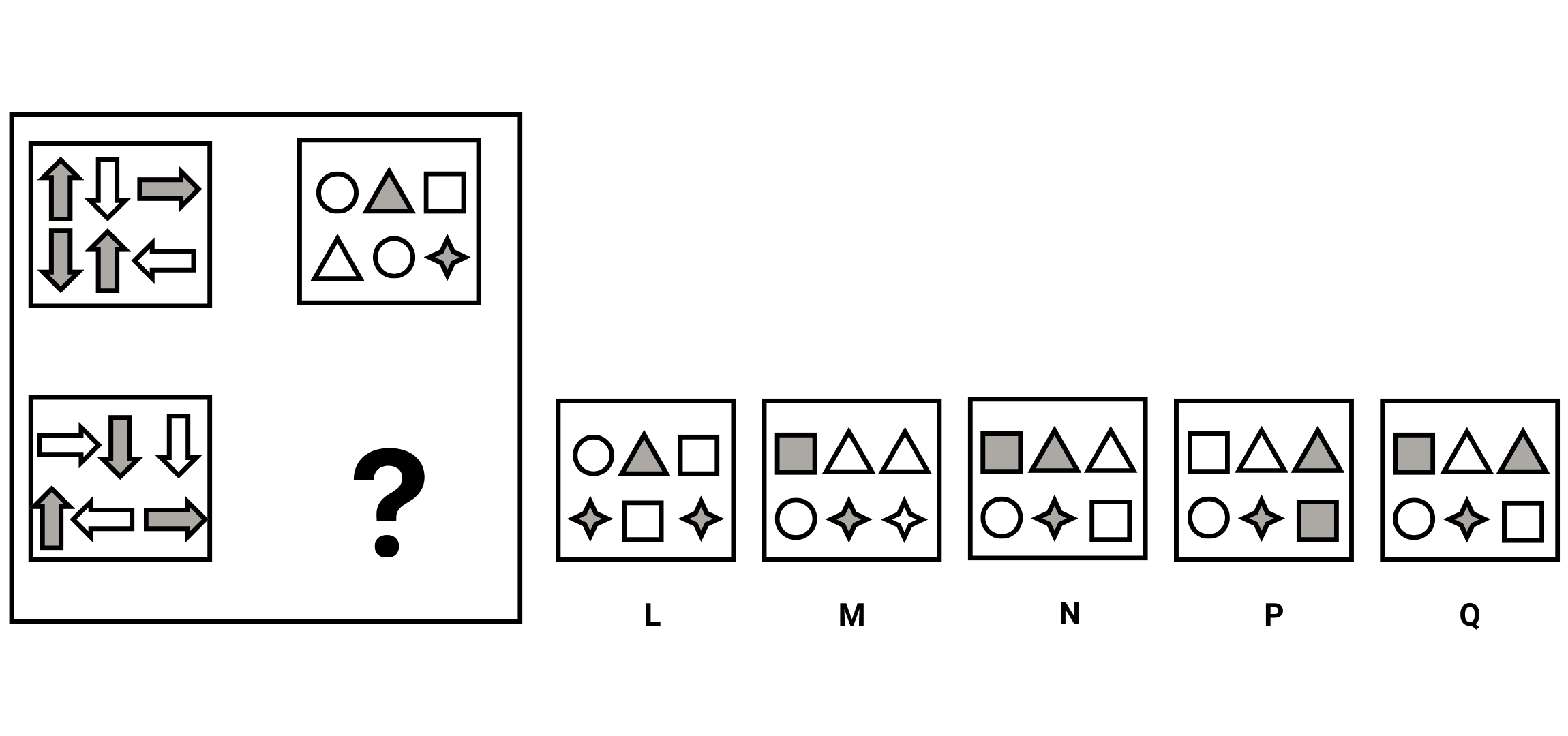
Answer and explanation
Answer: D. Each arrow corresponds to a shape, and the color is inverted.
Explanation: Each arrow maps to a specific shape, and the shape's color is the inverse of the arrow's color, following the transformation pattern across the sequence.
Left arrow → four-point star
Up arrow → circle
Down arrow → triangle
Right arrow → square
The abstract reasoning test evaluates a candidate's ability to identify logical relationships and solve complex visual problems. It measures one's capacity to analyze patterns and make quick, accurate decisions under test conditions. Strong mastery of this type of reasoning is essential for success in environments where data analysis and information structuring are critical.
Problem Solving (AdvanceD.
This test includes 10 questions and should be completed in 10 minutes.
Problem solving is essential for many roles, especially those requiring quick, effective analysis of complex situations. This test assesses a candidate's ability to:
- Understand and interpret textual and numerical information
- Apply critical and logical reasoning to solve problems
- Analyze tables and structured data
- Make effective decisions under time pressure
Example 1: Banking Throughput Calculation
A bank employs 50 financial advisors who together process 200 mortgage files in 10 days. All advisors work at the same productivity level.
After a restructuring, the team is reduced to 40 advisors, and they must process 240 files.
How many days will the new team need to complete the 240 files?
- 12 days
- 15 days
- 18 days
- 20 days
Answer and explanation
Answer: B. 15 days
Solution: 50 advisors process 200 files in 10 days → 1 advisor = 4 files / 10 days = 0.4 file/day. 40 advisors → 40 × 0.4 = 16 files/day. 240 ÷ 16 = 15 days.
Example 2: Asset Management
A wealth manager invests 40% of a client's capital in bonds and keeps 20% of the remainder in cash. The next day, they reallocate 50% of the remaining funds into stocks and keep the balance in cash.
Overall, what percentage of the initial capital was kept in cash?
- 20%
- 30%
- 36%
- 40%
Answer and explanation
Answer: 36%
Initially, 40% of the capital is invested in bonds, leaving 60%. Of this 60%, 20% is kept in cash: 0.20 × 60% = 12%. The remaining balance is 48% (i.e., 60% - 12%). Then, 50% of the remaining 48% is invested in stocks, which means 50% is still kept in cash: 0.50 × 48% = 24%. Total cash: 12% + 24% = 36%.
Example 3: Offsetting Client Losses
A bank lost 16 clients in the last quarter, each generating an average revenue of €5,000, resulting in a significant financial loss. During the same period, it acquired 18 new clients, generating revenue of €3,500 each.
How many new clients are needed for the bank to fully offset the financial loss caused by the departure of former clients?
- 10
- 5
- 2
- 7
Answer and explanation
Answer: B. 5
The bank lost 16 clients, each generating €5,000, resulting in a total loss of €80,000. During the same period, 18 new clients were acquired, bringing in €3,500 each, for a total of 18 × €3,500 = €63,000. The difference between the lost revenue and the new revenue is €80,000 - €63,000 = €17,000. To cover this shortfall, the bank must acquire additional clients. Since each new client brings in €3,500, the number of additional clients needed is €17,000 ÷ €3,500 = 4.86, i.e., 5 new clients after rounding. Thus, by adding these 5 new clients, the bank fully offsets its initial loss.
The problem-solving test is designed to measure a candidate's ability to analyze complex situations and make well-informed decisions under pressure. This skill is essential in the banking sector, where employees must quickly evaluate financial and operational information in order to propose appropriate solutions. Good preparation for this test helps improve thinking speed, accuracy in data analysis, and effectiveness in solving problems in a demanding environment.
Personality Assessment Test
This test may include a variable number of questions and is not necessarily time-limited.
Personality assessment is a key part of the recruitment process, helping to better understand a candidate's behavior and predispositions in a professional setting. Several test models may be used, such as the Big Five, the MPI-6F, or other approaches tailored to the role's needs. Personality tests vary depending on the model used. For example, the MPI-6F is based on six primary factors defined by the HEXACO model, while other tests like the Big Five or custom assessments focus on different traits. Despite these differences, the questions asked in these tests are often similar and aim to measure key behavioral tendencies.
This test is designed to provide an in-depth overview of personality traits, helping evaluate the fit between a candidate and a specific position.
Example questions:
Choose the response that best describes the person you are today-not the person you would like to be.
- Example 1: I always double-check my work carefully to avoid any errors.
- Example 2: I particularly enjoy philosophical discussions and debates on complex topics.
- Example 3: I can easily adapt to new social situations and quickly build connections with strangers.
- Example 4: I prefer following established rules and procedures rather than improvising.
- Example 5: I often feel comfortable when I have to speak in public.
- Strongly disagree
- Disagree
- Neutral
- Agree
- Strongly agree
Interpreting Personality Test Results
In a personality test, there are no right or wrong answers. Each response is linked to a score that corresponds to a personality category defined by the test model. Based on the candidate's choices, a score is assigned to each evaluated dimension, allowing results to be classified into categories such as Low, Medium, or High. This classification is based on a comparative study using a representative sample, ensuring a reliable interpretation of the results.
Personality tests help recruiters gain a deeper understanding of a candidate's behavioral traits and aptitudes. They are not designed to eliminate profiles but to identify how well an individual fits a given work environment. The best way to prepare is to answer honestly and spontaneously, so the results accurately reflect your personality and how you interact in a professional setting.
Tips and Advice
The questions are generally of an easy to medium level, but your main challenge is time management. The key is not to get stuck on a single question - move on to the next one and return later if you have time left.
Good preparation involves practicing with similar question types. Once you understand the logic behind them, you'll be able to answer more quickly and naturally. Your greatest strength is preparation, which gives you a significant advantage over an unprepared candidate.
FAQ - Maki Tests & Online Preparation (TestsCareers)
What is TestsCareers?
TestsCareers is an online platform for practicing psychometric and assessment tests. It allows you to train with realistic timed simulations, access detailed explanations, track your progress with full statistics, and receive a personalized report after each test. The goal: to improve quickly and feel confident on the day of the real assessment.
What is a Maki test?
A Maki test is a short, timed online assessment used by recruiters to measure your abilities (logical reasoning, numerical reasoning, language, soft skills, personality, and professional judgment).
How long does a Maki test last?
Each test typically lasts between 5 and 15 minutes. Personality tests, however, may not have a strict time limit.
What types of Maki tests exist?
- Logical and numerical reasoning
- Verbal comprehension
- Attention to detail
- Language tests (aligned with CEFR levels)
- Soft skills (situational judgment, adaptability, communication, leadership)
- Job-specific tests (finance, marketing, customer service, IT, etc.)
Will I receive my results after a Maki test?
On Maki, you don't always receive your score - the final decision is up to the hiring company.
On TestsCareers, you always get full access to your results: overall score, correct and incorrect answers, detailed explanations, and a complete progress report.
Can I retake a Maki test?
No, unless there's a verified technical issue. Each test is unique to ensure fairness among candidates.
However, on our preparation platform, you can replay your simulations up to 10 times to improve your performance.
Can I take the test on a phone or tablet?
Technically yes, but it's strongly discouraged. Recruiters recommend using a computer with an up-to-date version of Google Chrome.
On TestsCareers, you can also use our mobile app, but for optimal comfort (especially for image-based questions), we recommend using a computer.
What if my Maki link has expired?
An expired link cannot be reopened by Maki. Contact the recruiter directly to find out if a new invitation can be sent.
Why did my test suddenly stop?
Tests are timed. In addition, if an activity requires full screen mode and you exit it twice, the test automatically ends.
Is there a universal passing score?
No. Maki results don't have a standard passing score - each company defines its own criteria.
On TestsCareers, you can compare your scores with other candidates' statistics and identify your strengths and areas for improvement.
How can I effectively prepare for Maki tests?
The key is to practice under real test conditions, with a timer and similar questions.
The TestsCareers pack includes:
- 12 timed simulations
- 450+ questions covering reasoning, languages, and soft skills
- Full reports and detailed explanations
- Personalized progress tracking
Can I change the language of my Maki test?
Only if the evaluation allows it (globe icon in the interface). Otherwise, you must take it in the language selected by the recruiter.
On our platform, you can choose your practice packs in French and English.
Loading or freezing issues - what should I do?
Refresh the page, close unnecessary tabs or apps, clear your cache, use an updated version of Chrome, check your internet connection, and if needed, try another computer.
Camera or microphone not detected
In Chrome, click the padlock icon in the address bar and allow Camera and Microphone. Also check your device's system settings.
Will I receive my score?
On Maki, the company decides whether you receive your results. In some cases, the score is not shared with candidates.
With TestsCareers, you always receive a full report: overall score, detailed explanations, and progress statistics.
Who should I contact about my application status?
Contact the company where you applied directly. The assessment platform does not intervene in hiring decisions.
Do you offer accommodations (extra time, etc.)?
Yes, accommodations can be arranged if you inform the recruiter or the evaluation team in advance.
Quick tips for success
Use a computer with Chrome, a stable internet connection, and a quiet environment. Read the instructions carefully, manage your time well, move forward, and return to difficult questions later.
Where can I practice for free?
Start with a free demo test on TestsCareers, then move on to the full timed simulations pack to make faster progress.
What does the TestsCareers pack include?
12 simulations (reasoning, language, SJT, personality), over 450 questions, detailed explanations, progress reports, and instant access. Click here for a detailed description.
Conclusion
With Maki becoming an increasingly common part of recruitment processes, serious preparation is now essential. The tests are short but designed to distinguish top candidates from hundreds of others.
Our preparation pack gives you everything you need to succeed: realistic practice sessions, detailed explanations, and timed simulations that mirror recruiter expectations.
Get ready, stand out, and move forward with confidence.